

Showing posts with label Travel. Show all posts
Showing posts with label Travel. Show all posts
Saturday, September 29, 2018
Me Gusta
ESTE FRASCO DE BALSA, una especie de calabaza gigante para almacenar la tuba de Colima. The beverage became so popular in Western Mexico (it still is) that a decree by viceroy Luis de Velasco in 1610 prohibited the production of tuba because it had become the beverage of choice for the local Mexican population in the provinces of Colima and Zacatula and the sales of Castilian grape wine had dropped, costing Spain a large amount of tax revenue. Taverns and even churches replaced the Castilian spirit with the tuba, which prompted its prohibition and the deportation of Filipinos who produced it. "It can be averted, provided all the Indian natives of the said Filipinas Islands are shipped and returned to them, that the palm groves and vessels with which the wine is made be burnt, the palm trees felled, and severe penalties imposed on whomever remains or returns to making that wine.” Geographer Henry J. Bruman traced the Pinoy roots of Mexican palm toddy and its distillation in The Hispanic American Historical Review and Geographical Review. ¡Compuesta, y conquista al revés, señores! Here's to harvest season.


Friday, August 31, 2018
Suitcase Delights
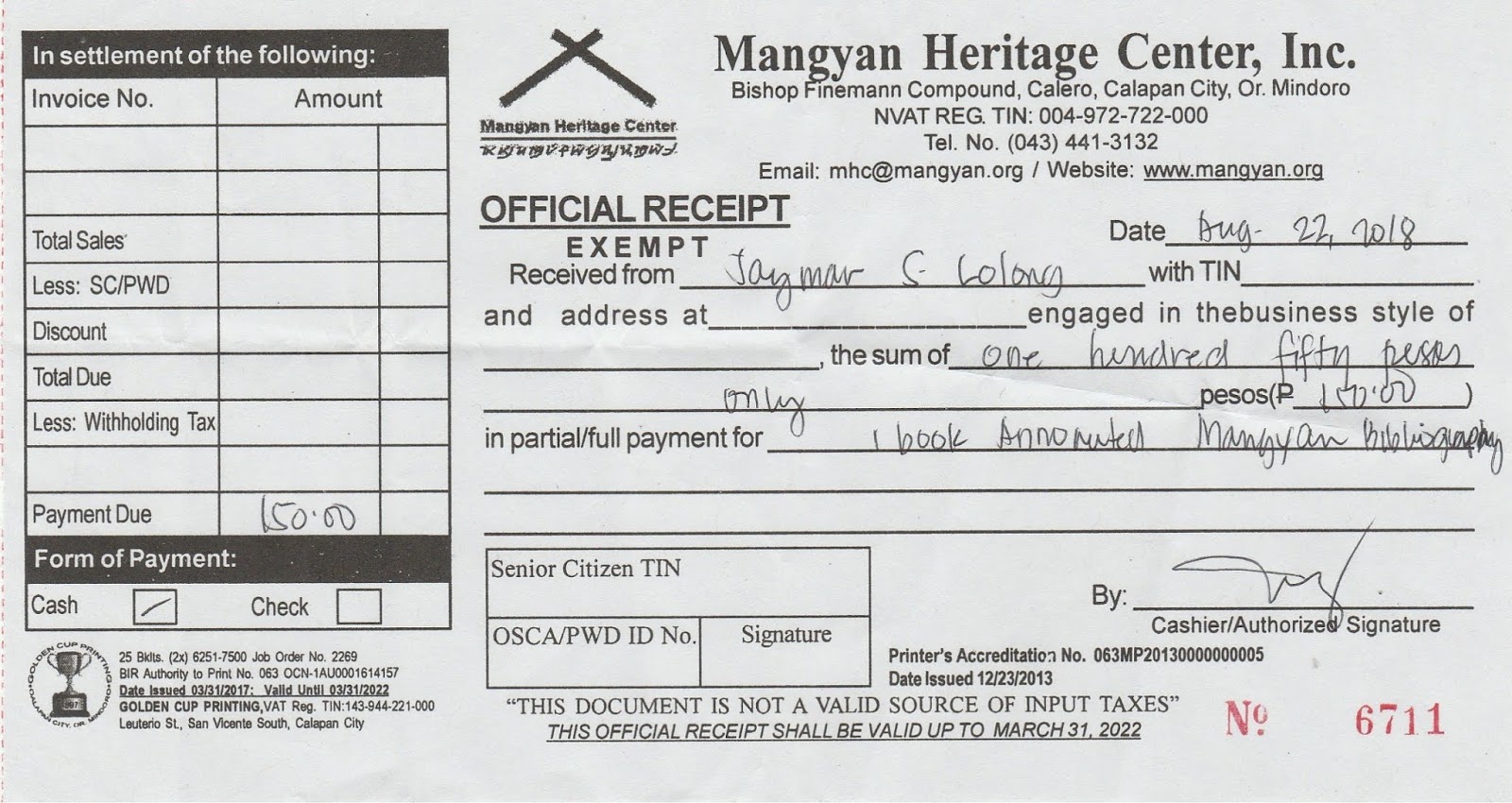
TESS GOT FOR ME on her recent trip to Mindoro (through a nephew studying in Calapan) this rare copy of Antoon Postma's monumental book Annotated Mangyan Bibliography, 1570-1988 for less than the price of a bagful of Pinamalayan banana chips as reading companion. And a score of other Pinoy expatriate collector's books, mostly from New Day Publishers, for less than $40. Thanks for these awesome pasalubongs, Mom!



 |
| A thriving Pinamalayan enterprise |
Friday, February 2, 2018
The Other Manilas
TWO HISTORIC BATTLES OF MANILA were fought in the month of February. From Wiki: "The Battle of Manila (1899), the first and largest battle of the Philippine–American War, was fought on February 4–5, 1899, between 19,000 Americans and 15,000 Filipinos. Armed conflict broke out when American troops, under orders to turn away insurgents from their encampment, fired upon an encroaching group of Filipinos. Philippine President Emilio Aguinaldo attempted to broker a ceasefire, but American General Elwell Stephen Otis rejected it and fighting escalated the next day. It ended in an American victory, although minor skirmishes continued for several days afterward. The Battle of Manila (1945), fought on February 3–March 3, 1945, was a major battle of the Philippine campaign of 1944-45, during the Second World War. It was fought by American and Filipino forces against Japanese troops in Manila, the capital city of the Philippines. The month-long battle, which resulted in the death of over 100,000 civilians and the complete devastation of the city, was the scene of the worst urban fighting in the Pacific theater. Japanese forces committed mass murder against Filipino civilians during the battle. Along with massive loss of life, the battle also destroyed architectural and cultural heritage dating back to the city's foundation." To commemorate these events, and because it was too cold to do anything outside of the house on my day off, I scoured the internet for images of the seven towns in America also named "Manila". With the exception of the one in California, which was founded at the end of World War II, they all got their name from the American victory in the Battle of Manila Bay during the Spanish-American War--to celebrate the acquisition of a new territorial possession whose capital city they would raze to rubble decades later? My wish is to visit all seven towns and send mail to my New York address with their postmark.
1. Manila, Arizona--population unknown (Navajo County)
2. Manila, Arkansas--population 3,055 (Mississippi County)
4. Manila, Kentucky--population unknown (Johnson County)
6. Manila, Utah--population 310 (Daggett County)
1. Manila, Arizona--population unknown (Navajo County)
 |
| Abandoned Texaco gas station in Manila, Arizona |
 |
| Abandoned trailer in Manila, Arizona |
2. Manila, Arkansas--population 3,055 (Mississippi County)
 |
| Downtown Manila, Arkansas |
 |
| Manila, Arkansas Middle School girls' basketball team |
3. Manila, California--population 1000 (Humboldt County)
 |
| Manila Dunes Recreation Area, Manila, California |
 |
| Manila, California road sign |
4. Manila, Kentucky--population unknown (Johnson County)
 |
| Manila, Kentucky Skate Shop |
5. Manila, Missouri--population unknown (Pettis County)
 |
| Manila, Missouri map T-shirt |
6. Manila, Utah--population 310 (Daggett County)
 |
| Manila, Utah road sign |
 |
| Manila, Utah road sign |
 |
| The town of Manila, Utah |
7. Manila, West Virginia--population unknown (Boone County)
 |
| Willie Stollings Cemetery, Manila, West Virginia |
Thursday, October 19, 2017


Wednesday, June 21, 2017
Canal Town
TEN MINUTES from the Hopatcong house is Waterloo Village, a restored 19th century settlement on the banks of the old Morris Canal, the waterway used to transport anthracite coal from Pennsylvania's Lehigh Valley to New York City during the American Industrial Revolution. For canal workers then, the village was an overnight rest stop on the two-day journey to the coast, and it had "all the accommodations necessary to service the needs of a canal operation, including an inn, a general store, a blacksmith shop to service the mules on the canal, and a watermill" (Wiki). But there were other travelers. The alewife herring, anadromous fish like salmon, also used the waterway as a conduit to travel up the Delaware River from the Atlantic Ocean to Lake Hopatcong, the reservoir in the highlands that fed the canal. There they became landlocked with the building of the dam in the 1800s, but thrived so well in their new habitat that they are now the abundant basis of the lake's fish food chain.
 |
| The grist mill, Waterloo Village |
Friday, June 2, 2017
Cool Without The Coal
MAUCH CHUNK, PA was founded in the early 1800s during the heyday of anthracite coal mining, but when coal use declined in the 20th century, the town reinvented itself as a tourist destination by taking the corpse, and name, of Native American Olympian Jim Thorpe who died in 1953 but whose home state of Oklahoma would not bury with honors. Today, the "Switzerland of America" is a cool weekend getaway two hours from the city (one hour from Hopatcong), and was named by Rand McNally as among the ten Best Small Towns in America. From Wiki: "Geologically, the largest and most concentrated anthracite deposit in the world is found in northeastern Pennsylvania; the deposit contains 480 square miles of coal-bearing rock which originally held 22.8 billion short tons (20.68 billion tonnes) of anthracite." Thought you have eternal rest? Watch out, poor Jim Thorpe, Trump will get you rolling over in your grave.
 |
| St. Mark and St. John's Episcopal Church, Jim Thorpe, PA |
Wednesday, April 5, 2017
Bermuda!
FROZEN STEAKS, Spam, spicy Ligo, Lucky Me noodles, everything needed to cook inside the club is packed to avoid paying $20 each for a restaurant meal and limit buying Bermuda groceries. Temperature forecast averages 70F next week, not sure if it's warm enough to go in the water, but bringing the snorkeling gear anyway ($10 each on eBay). Ready to see some coconut trees again on Friday.



Tuesday, February 14, 2017
Good To Go
SPRING BREAK in the Somers Isles for some snorkeling, and visita iglesia for the wife, except that Bermuda has only six Catholic churches. I think the Unfinished Church will make a good seventh. Pricey trip, but sometimes necessary. And today is a good day to buy. Now what was that about Trump?


Friday, August 19, 2016
The Brink Of The Bronx
 |
| The Hall of Fame on a cliff overlooking the Harlem River |
After my master in library science degree, I worked a city job on campus with the title of Assistant to Higher Education Officer, managing faculty development efforts and college board meetings as coordinator of its Center for Teaching Excellence, then directed by Jewish poet Harriet Shenkman. Coming home one afternoon, I found in the mailbox a letter from the Minneapolis Hiring Center, offering me a federal job that I had applied to years before and had forgotten about, asking me to report to a Human Resources office in Newark so that my name can be enrolled in the next class that would run for three months in a boot camp in Georgia. The letter also emphasized that I would be required to do the 1.5 mile run in 15 minutes or less, taken in two attempts, otherwise fail the academy and be literally sent home right there on the tracks. Now, I have spent all my adult life in the academic world and the federal government was terra incognita. I knew that the academic part of it would be routine, but my cardio stamina was laughable; I had been smoking for as long as I could remember, and quitting to begin a daily regimen of running would be like asking me to climb Mt. Washington in the middle of February. What if I didn't make the run? There would be no job to come back to, because the offer came in the middle of the semester and gave me no option to finish my duties until the end of the term, to be able to come back if I did not pass the academy or like the new job.
Decisions, decisions. As I was consumed by my dilemma, the Hall of Fame became the leap of faith, the brink of destruction, the precipice of doom. Should I stay or should I go, step down or turn down, resign or decline, quit or forfeit? During break periods, I would linger at the Hall of Fame hoping for an epiphany, but while the advice of the heroes (stolid like Easter Island moais looking beyond the horizon of their barren ground) were muted, the voice of our financial situation was thunderous. We had recently bought a house, and the monthly mortgage snapped up my wife's Wells Fargo salary, while mine was a poor supplement to take care of the rest of the bills. The starting salary and benefits of the job offer were great. Academics or economics? That was the question. Gotta do what I gotta do, the 1.5 mile run be damned. I had to take my chances. It's a go. That crucial afternoon I submitted my resignation, I stopped by the Hall of Fame once again and went through the rows of heroes, hoping to find one that was in the profession of customs, but never found it.
So in early May, nicotine-free, I kissed my family goodbye in Penn Station and was on Amtrak bound for Savannah, all alone and wondering if I had made the right decision as I watched the late spring trees outside morph into subtropical, the anxiety weighing me down full force like the ugly Spanish moss all around when I arrived. A van with a U.S. government license plate was waiting at the station, and the driver, a talkative officer from Long Island, delivered me and seven other rail-opting hopefuls under the porte cochere of a Marriott hotel in FLETC (called "Fletsie" by oldtimers), still an hour away in a town called Glynco in the middle of southern Georgia pinelands. A Marriott hotel in boot camp? What the f---? (Obviously, Marriott executives are well-connected to the federal government.) This was going to be a breeze, my ignorant mind told me. How wrong I was. Little did I know that the hotel would be a requisite comfort after every exhausting day of physical training and shin splints, peer pressure, asshole instructors, weekly exams on dull topics, lack of sleep, crappy food in the cafeteria, the heat, mosquitoes, anything you could think of to humiliate the academic brat in you on top of the homesickness. For ninety days.
SEVEN YEARS LATER, I am still amazed at how I survived those ninety days, and wonder if I had made the right decision. I graduated from the academy with a bling on my diploma, my proud family flying in from New York to be by my side. And oh yes, I made the 1.5 mile run in 14.34 minutes on my second attempt, thanks to the adrenaline and the potassium and the FedExed adobo and the prayers of my family (I always thought mine had no clout). But when I returned to the work unit in Newark the following week, I saw how different the new job was. Within a short period of time, I realized that whereas, in my previous job, I could express my dissent to the president of the college on any issue, in this new job you just don't jump ranks when speaking your mind and there were hierarchy protocols that must be sternly adhered to, and that the orders of my first-line supervisor were like royal decrees, no questions asked. Intellectual and academic freedom in the job was, to understate it, limited. We were instructed never to share security-compromising information on social media, including work-related photographs and personal identification, duty details, any information that may compromise the classified nature of the job. (I am even afraid as I write this post that I may have to take it down in the future.) For years, the task of writing made me sick, and even now as I recuperate, I am still blind to the boundaries of its new confines. We issue charges and penalties everyday and must build a firewall between us and the public to prevent vindictive offenders from being able to track us down. And in the wake of the recent police shootings, we are required to change into street clothes before going home to avoid being assassinated. This is a small price to pay in exchange for the bacon that I bring home every two weeks, surely a day on the beach compared to that of a recruit deployed in Iraq. And after seven years of service, I have the tenure and salary of a full professor, health and life insurance, tax-free contributions to a retirement fund, leave entitlement, and most of all, no papers to bring home and grade at the end of the day. We are able to buy a summer home in the lakes region of northwest Jersey, and save for our daughter's college fund. Did I make the right decision? I still do not know, and one of these weekends, I'd like to go back to University Heights to see if this time, I can find the answer. Until then, the response to my first-line supervisor's orders will be the same: Hooah!


Monday, July 25, 2016
Lake Hopatcong Summer
CHECK OUT the work of watercolorist Angelito L David (no period after the middle initial). This more venerable Jersey Pinoy lives in Elizabeth and goes to Lake Hopatcong to paint. Awesome.
Angelito L David, 209 Springfield Road, Elizabeth, NJ 07208 (908) 289-6829
Angelito L David, 209 Springfield Road, Elizabeth, NJ 07208 (908) 289-6829
 |
| "Lake Hopatcong Summer" 14.5 x 20.5" March 2010 Second Place, National Arts Program |
Sunday, June 5, 2016
Freebies In The Mail


GO AHEAD; make sinigang out of that muskie. Jersey is far from being just a polluted suburb. For the most versatile and durable rod and reel combo that won't break the bank, respected angler Owen James Burke (not the mystery novelist) recommends pairing the Shakespeare Ugly Stik GX2 6.5 ft Medium Heavy with the Penn Battle II 5000. As for my own, no-name gear, it came from a garage sale in Budd Lake.
Friday, February 5, 2016


Wednesday, February 18, 2009
Forty Niner And His Daughter
BUT HER SHOES are #7. I thought I should take advantage of this ditty to mark my forty-ninth year to heaven. Mom took this picture by the River Seine a couple of years ago.

Saturday, November 22, 2008
Hawthornden On My Mind


AN EXPERIENCE THAT I will always remember is my fellowship at the Hawthornden Castle International Retreat for Writers in Lasswade, Scotland, from 19 November to 16 December of 2000, exactly eight years ago today. The memory is timely; it was also autumn and post-US presidential election period, but then there was a bitter contest between George W. Bush and Al Gore about the election results, particularly in Florida. In fact, it was then when I learned that the meaning of the word "chad" other than a country in Africa was a paper fragment created when a hole is made in a ballot card, from reading The Scotsman newspaper in the castle living room. My candidate Al Gore had apparently lost because "hanging," "dimpled" and "pregnant" chads which had been punched, though not completely, on ballot cards were not counted to his favor. I had become an American citizen in April of that year and was happy to have exercised my right to vote, but was very disappointed. Today, after eight years of Republican dynasty, I am happy to see a Democrat get elected once again, and what a president-elect he is. I know this has been said countless times, but I am going to say it again: Barack Obama will lead this country through the challenges of the times. That said, please allow me to sit back and indulge in a little nostalgia.
On November 18, 2000, I took a Northwest Airlines flight from JFK to Amsterdam Schiphol Airport, then transferred to a smaller KLM plane to Edinburgh (pronounced Edin-burrah). I took a cab with a courteous driver who drove me to the castle for about twenty minutes, lamenting how tourists had descended on his town since a ski path had been carved out of a hillside along our way. I arrived in the castle just before dinner, was welcomed by Amy, the administrator, and was immediately led to a room called Jonson on the third level, my home for the next four weeks. The castle had winding stairways that provided a challenge as I dragged one of my two heavy luggage upstairs (sorry, no elevators in ancient castles), but Amy, despite her little frame, did the other without effort; she had obviously done this for other fellows before. Not too long after, it was dinner time and sherry was served, on the house, as Amy welcomed the fellows formally.
What followed was a succession of days of writing privilege; as silence was maintained in the castle at all times, except dinner. From the castle through the trees, one could actually hear the waters of the River North Esk. Lunch, which consisted of simple fare like sandwiches and a thermos bottle of hot soup, was brought to the fellows' rooms, who were left on their own most of the day. Some fellows packed their lunches and caught the early bus that passed by the castle gate to make day trips to Edinburgh, the capital city, or to see Rosslyn Chapel for its Knights Templar history. Some simply stayed and made the river walk behind the castle. I went to the city on days when I craved good old rice, which did not seem to be part of the castle menu. Around downtown, there were Chinese and Indian restaurants where I had beef broccoli or chicken curry with rice to quell my Asian stomach. After lunch, I wandered about Princes (not Princess or Prince's) Street, the main thoroughfare, dominated by the majestic Edinburgh Castle from Castle Rock, before catching the last bus to Midlothian, where my castle was. At dinner, the Garden Room became alive as fellows shared stories about their ventures of the day. Sherry flowed; there was a list to tally how many glasses one had had for the evening, to be charged upon checkout. I became friends with Tom Kennedy, an American living in Copenhagen who used to live in Jackson Heights, New York, and Parm Kaur, a British poet from London with a Punjabi background. Maybe because she was the only other minority writer and smoker in the group, we became chat buddies. One evening, the shy kitchen ladies prepared haggis, that traditional Scottish dish of sheep's stomach stuffed with liver, heart, lungs and a bunch of other goodies only a Filipino could also eat. I was expecting it to taste like dinuguan or higado, but was disappointed as it was mostly bland.
Hawthornden Castle sat on a secluded crag overlooking the River North Esk, providing impressive views of the surrounding glen. It was the home of poet William Drummond, who built a new house around a ruined 15th century tower in 1638. The castle remained home to the Drummonds until 1970 and is now owned by philanthropist Drue Heinz, publisher of The Paris Review and widow of H.J. Heinz of catsup fame. From what I remember, there was a working water well on its courtyard, and a cave further down where Robert the Bruce, King of the Scots from 1306 to 1329, was said to have taken shelter. By the gate, there was a little house that Mary Sharratt used to call "the gamekeeper's cottage." The bathroom of the castle had an ancient toilet bowl that flushed by pulling a chain, but it also had a sunroof that gave one a piece of Scottish sky while taking a dump.
Whatever, the silence and privacy were what mattered. In the retreat, I got to polish my short story The Capture, which early that year won Best Fiction in the Philippines Free Press Literary Awards. Later, it was shortlisted in the Fish Short Story Prize sponsored by Fish Publishing in Durrus, Ireland. Before leaving, I wrote a poem for Drue Heinz in the logbook and donated a copy of A Habit of Shores: Filipino Poetry and Verse from English to the castle library. All in all, it had been a great experience, and today, sitting in my cubbyhole at Rosenthal Library, aging and arthritic, I relive the memory and hope that I will have a similar luck someday.
Here is a picture of the fellows in the Dining Room. L-R: Mary Sharratt, Linda Leith, Parmjit Kaur, Patricia Duncker, Amy the administrator, Thomas E. Kennedy and yours truly. Also, a shot on Calton Hill with the Dugald Stewart Monument in the background, and a picture of Edinburgh Castle, thanks to Wikipedia.


Hawthornden Castle International Retreat for Writers, Lasswade, Midlothian EH18 1EG, Scotland, United Kingdom, phone 44 (0) 131 440 2180, fax 44 (0) 131 440 1989, contact the Administrator


Saturday, November 8, 2008
The Cheapest Property In The Adirondacks
 IT IS OFFICIAL. I am the proud owner of half an acre of hillside property in Port Henry, NY with a "fixer-upper" (euphemism for decrepit) farmhouse. I had to take the Amtrak to Albany to close the deal and obtain the deed from the lovely wife of a young investor. It was a great trip along the Hudson River, and the transaction went smoothly. But where on earth is Port Henry? As people asked, "Ano bang meron sa Port Henry?" To justify my decision, which people may think is as stupid as Seward's purchase of Alaska, here are my reasons: 1. Location, location, location. Port Henry is in the Adirondack State Park in upstate New York, "an area of unparalleled beauty.” It is the largest park in America, covering 6.1 million acres, a land area about the size of the Yellowstone, Yosemite, Grand Canyon and Great Smoky Mountains National Parks combined. I have always dreamed of living in a mountain cabin by the lake (preferably with a fireplace), and live an idyllic Thoreau-like life. A kid who grew up among the rice paddies of Pinamalayan, Oriental Mindoro in the Philippines, I have always had this idea of an American home, slightly different from that of my friend Susan Lara: a white picket fenced suburban home with a dog named “Spotty” running around. Maybe I’m just a rural guy. Anyway, Port Henry is a small village between the shores of Lake Champlain and the foothills of the Adirondack Mountains, and reminds me of Scotland and even Sagada. Maybe someday, I can invite my Filipino friends over.
2. Accessibility. Port Henry is on the Amtrak's Adirondack route between New York City and Montreal (Map above), which was proclaimed one of the ten most scenic train trips in the world by National Geographic Traveler Magazine. The train departs Penn Station in Manhattan early in the morning and follows the banks of the Hudson River and the shores of Lake Champlain through historic towns and pristine woodlands in upstate New York to the Canadian border, terminating at Gare Centrale in downtown Montreal before dinner. One way trip to PH costs about $50, and there is a food car where one can buy hot instant Ramen and sandwiches. Although PH's train station is no Grand Central and does not even have a passenger waiting platform (one has to use a stool to step up and down the train), it is a piece of architectural history, being built in the 1880's when PH was an iron mine port. At present, it is staffed by friendly senior citizens who bring the stool in and out, and get to use the depot for their own activities in return. PH is also along the route of a major inland waterway that runs from New York City to Quebec City. One could actually sail inland from the Atlantic through the Verazzano Narrows in NYC--Hudson River--Champlain Canal--Lake Champlain--Richelieu River--Chambly Canal--St. Lawrence River--Quebec City in the Gaspe Peninsula, back to the Atlantic. This is a dream cruise that I would like to take or do before I die. Along this water route, PH has a marina near Bulwagga Bay, where legendary lake monster "Champ" has been sighted many times.
3. Nearby institutions. Middlebury College, Robert Frost's summer home and the famous Bread Loaf Writers' Conference are about forty five minutes away, across Crown Point Bridge on Lake Champlain. Meadowmount Summer School of Music (where artists like Yo-Yo Ma and Itzhak Perlman trained) is fifteen minutes north in Westport. The University of Vermont at Burlington and SUNY Plattsburgh are about an hour away. If you don't want to leave town, there is a small public library downtown, and a professional theater company in nearby Westport.
4. Cost. I got the property for about seven thousand bucks, thanks to Plattsburgh Craigslist. It is cheaper than a used car.
5. Finally, because I am a crazy dreamer. I think I have found my other retirement home, apart from our ancestral house in Pinamalayan, Oriental Mindoro.
Watch for updates on my progress rehabilitating the house until it is ready for housewarming, open to all Pinoys who can come. I also have a title for a piece: Port of Entry to Port Henry.
Here are pictures of the house on 109 Stone Street, the bathroom (those are not bird droppings on the tub), and Sara feeding the gulls on Lake Champlain, five minutes away.


Subscribe to:
Posts (Atom)